
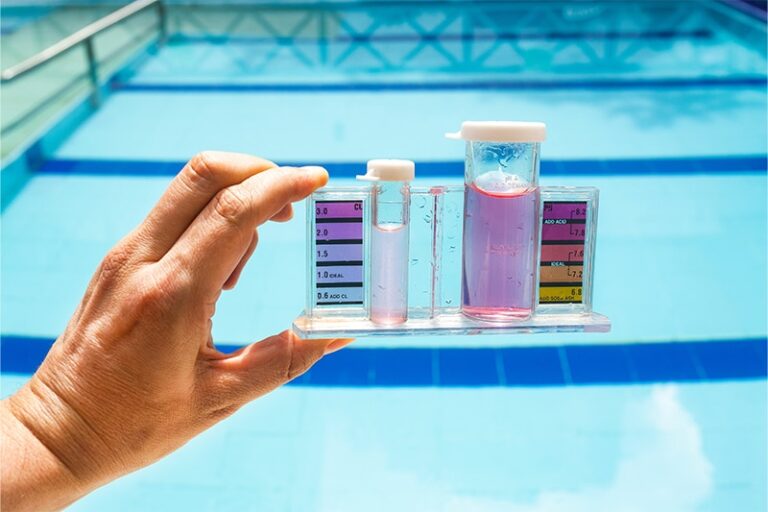
If you run a pool in Denver or anywhere along Colorado’s Front Range, you already know: the test kit you choose drives everything from daily dosing to passing inspection. The best pool water testing kits for commercial use deliver precise results, clear records, and fast workflows your staff can actually follow on a busy shift. At The Aqueous Solution, we help aquatic teams in Denver, Metro Denver, Colorado Springs, and Fort Collins choose kits that meet local code and hold up to real-world use.
Key Takeaways
- The best pool water testing kits for commercial use must meet code-level accuracy (pH ±0.2) and use accepted methods like FAS-DPD for chlorine across required parameters.
- Pair FAS-DPD titration with a multi-parameter photometer and a calibrated pH/ORP meter to balance precision, speed, and consistency across staff.
- Select kits with data logging, timestamps, and CSV/app exports to streamline inspections and maintain traceable corrective actions.
- Choose rugged, waterproof instruments with easy calibration, QC checks, and fresh, lot-tracked reagents to ensure repeatable results and control total cost of ownership.
- Follow a compliant schedule—test chlorine/bromine and pH every 2–4 hours, check alkalinity and hardness weekly, and verify CYA and metals as needed—and document every adjustment.
What Commercial Pools Need From a Test Kit
Required Parameters and Local Code Expectations
For commercial facilities in Denver and surrounding jurisdictions, your kit needs to cover the core parameters with code-level accuracy:
- Free and total chlorine (or bromine, if used)
- pH
- Total alkalinity
- Calcium hardness
- Cyanuric acid (if stabilized chlorine is used)
- Copper (if ionizers are installed)
- ORP and conductivity where systems require it, plus ozone if applicable
Local health departments across Metro Denver, Colorado Springs, and Fort Collins expect kits that can read pH within ±0.2 units and use FAS-DPD or DPD methods for chlorine. That precision isn’t just a nice-to-have. It’s a compliance requirement, and it keeps swimmers safe.
Accuracy, Resolution, and Repeatability
Commercial dosing decisions hinge on small differences. That’s why FAS-DPD titration kits remain a gold standard for chlorine: they provide a clear endpoint and fine resolution at typical pool ranges. Photometers and spectrophotometers add lab-grade consistency, especially valuable when multiple staff members are testing throughout the day. Better resolution and repeatability mean fewer chemical swings and tighter control.
Speed, Throughput, and Staffing Realities
Busy Denver hotel pool? High-use recreation center in Aurora or Lakewood? You need results fast. Digital photometers shorten testing time and reduce interpretation errors, ideal when supervisors delegate testing across rotating staff. FAS-DPD is still fast for chlorine, but a digital unit can handle multi-analyte testing in a single run, which helps you keep pace during peak hours.
Traceability, Recordkeeping, and Audit Readiness
Most Colorado health departments want organized logs and clear corrective actions, retained for several years. Kits that log data, timestamp results, and export to CSV or app dashboards make surprise inspections far less stressful. If you can show a clean chain of readings plus what you did to fix out-of-range results, you’re ahead of the curve.
Standards, Methods, and Regulatory Alignment
Look for test methods that align with NSF/ANSI standards and are explicitly accepted by your jurisdiction. Reagents should be fresh, lot-tracked, and from reputable manufacturers. The Aqueous Solution regularly helps facilities confirm method acceptance with local inspectors so you’re never guessing about compliance.
Types of Commercial Pool Test Kits
FAS-DPD Titration Kits for Chlorine Precision
If we had to pick one essential tool for commercial pools, it’s FAS-DPD titration for free and combined chlorine. It’s accurate, readable to the decimal, and widely accepted by health departments. For Denver-area facilities balancing indoor natatoriums and outdoor seasonal pools, FAS-DPD gives reliable control in both.
Photometers and Spectrophotometers for Multi-Analyte Testing
Photometers provide quick, digital readings for chlorine, pH, alkalinity, hardness, cyanuric acid, and more. Many units store results, flag out-of-range values, and export data via Bluetooth or USB. Aquatic centers in Denver and municipal facilities along the Front Range like that they reduce color-matching guesswork and standardize results across large teams.
Digital Meters for pH, ORP, and Conductivity
Handheld pH and ORP meters shine where continuous control matters, especially for pools with chemical controllers. Conductivity meters support salt systems and troubleshooting dilution issues. Choose meters with easy calibration routines, replaceable probes, and IP-rated housings that can survive the pump room.
Test Strips: Spot Checks and Triage Use
Test strips are quick and helpful for a fast read, but they’re not enough for regulatory testing. Use them for a mid-shift spot check or to triage an issue before you follow up with a titration or photometric test.
Ion-Selective Electrodes and Lab Backups
When you’re chasing a persistent stain, unexplained sanitizer demand, or metal issues, ion-selective electrodes and lab-grade methods help you dig deeper. Not everyday tools, but good to have access to through your vendor or a local lab when problems get weird.
Selection Criteria and Feature Checklist
Accuracy, Range, and Detection Method by Analyte
- Chlorine: FAS-DPD or DPD with fine resolution at operational levels
- pH: Accuracy to ±0.2 units minimum, finer if digital
- Alkalinity/Hardness/CYA: Methods with clear endpoints and documented interferences
- Bromine/Ozone/Copper: Methods accepted by your health department, with proper ranges
Calibration, QC Controls, and Verification Routines
Look for photometers and meters that include:
- One- or two-point calibration for pH and ORP
- Built-in verification checks or standards
- Easy-to-run QC routines your staff can complete at shift start